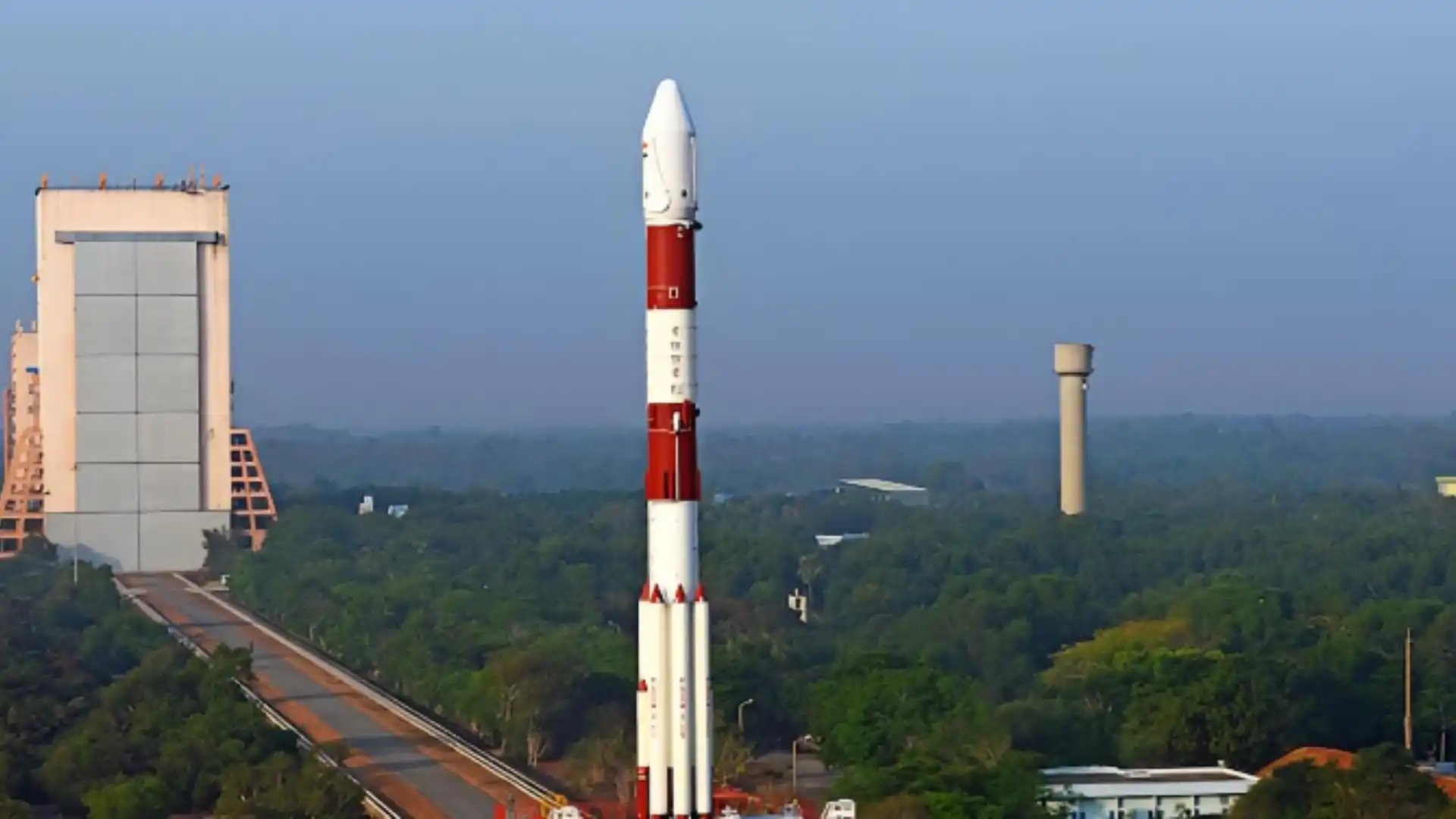
India PSLV rocket fails: India’s space program suffered a fresh setback Monday after the Indian Space Research Organisation’s Polar Satellite Launch Vehicle mission PSLV-C62 failed due to a critical anomaly during its third stage, resulting in the loss of all 16 satellites onboard, Jan. 12, 2026.
The failure marks the second consecutive setback for the PSLV — long considered India’s workhorse rocket — within eight months, raising concerns about reliability as the country pushes ahead with ambitious space plans.
The 260-ton, 44.4-meter-tall rocket lifted off on schedule at 10:18 a.m. IST from Satish Dhawan Space Centre in Sriharikota. According to ISRO, the first and second stages performed normally, but issues emerged toward the end of the third stage when abnormal roll rates and a deviation from the planned flight path were detected.
“The performance of the vehicle up to the end of the third stage was expected. Close to the end of the third stage, we are seeing more disturbance in the vehicle and subsequently, there was a deviation observed in the flight path,” ISRO Chairman V. Narayanan said from the Mission Control Centre. “We are analysing the data and we shall come back at the earliest.”
Satellites lost in the mission
The failed mission carried a mixed domestic and international payload. Among the Indian satellites lost was EOS-N1 (Anvesha), developed for advanced hyperspectral imaging with applications ranging from military surveillance to agriculture, urban planning and environmental monitoring.
Several technology demonstration satellites were also destroyed, including AayulSAT, India’s first on-orbit refueling experiment developed by OrbitAID Aerospace; MOI-1, an orbital artificial intelligence image laboratory built by Hyderabad-based startups TakeMe2Space and Eon Space Labs; and MIRA, billed as the world’s lightest space telescope at 502 grams.
International payloads from Nepal, Spain, Mauritius and Brazil were also aboard. Spain’s Kestrel Initial Demonstrator, a 25-kilogram capsule designed to test atmospheric re-entry technology before a planned splashdown in the South Pacific Ocean, was among those lost.
Also Read: Rajasthan REET Mains admit card 2025–26 released: how to download, official links and details
Second failure raises questions
The setback closely mirrors the PSLV-C61 failure in May 2025, which was also linked to issues during the third stage, reportedly involving changes in chamber pressure. Findings from that mission’s Failure Analysis Committee were not made public, prompting questions about transparency as India advances toward major milestones such as the Gaganyaan human spaceflight mission.
Monday’s launch was the 64th flight of the PSLV and ISRO’s 101st orbital launch attempt overall. Analysts say the back-to-back failures could dent confidence among domestic and international customers of ISRO’s commercial arm, NewSpace India Limited, which had arranged the rideshare mission.
ISRO said a detailed investigation is underway, but did not provide a timeline for when its findings will be released.

Chaitan Limkar is an entertainment writer specializing in movie reviews, box office collections, and web series coverage. With a sharp understanding of audience preferences and industry trends, he delivers accurate, engaging, and insight-driven content on films and digital streaming platforms. His writing focuses on honest reviews, reliable box office analysis, and timely entertainment news, helping readers stay updated with the latest happenings in cinema and OTT entertainment.