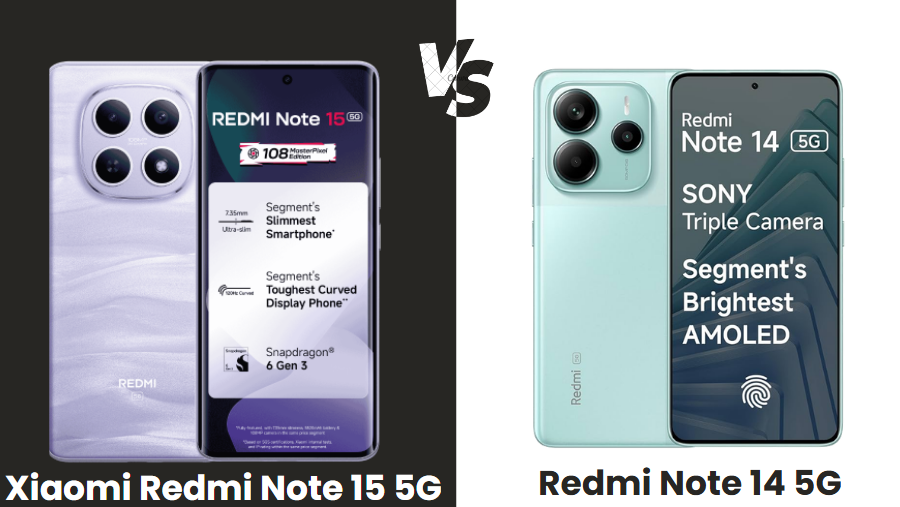
Xiaomi Redmi Note 15 5G vs Redmi Note 14 5G: Xiaomi’s Redmi Note series has always been a favorite among budget-conscious smartphone buyers, and the latest Redmi Note 15 5G continues that tradition. But how much better is it compared to last year’s Redmi Note 14 5G? We’ve tested both phones to help you decide which one deserves your hard-earned money.
What’s Actually New in the Redmi Note 15 5G?
The Redmi Note 15 5G isn’t a revolutionary upgrade, but Xiaomi has refined several key areas that matter in daily use. Think of it as the “director’s cut” of the Note 14 — the same foundation with meaningful improvements where they count.
Display: Bigger, Brighter, Tougher
The most noticeable change comes when you first pick up these phones. The Note 15 sports a larger 6.77-inch AMOLED display compared to the Note 14’s 6.67-inch screen. Both refresh at a smooth 120Hz, making scrolling through social media feel buttery smooth.
Where the Note 15 really pulls ahead is brightness. Its 3200 nits peak brightness outshines the Note 14’s 2100-3175 nits, making it significantly easier to read under harsh sunlight. If you frequently use your phone outdoors, this difference is immediately apparent.
Xiaomi also upgraded the screen protection from Gorilla Glass 5 to Dragon Crystal Glass. While both handle everyday drops reasonably well, the newer material offers better scratch resistance for those who prefer going case-free. Both displays support HDR10+ for vibrant streaming content.
Performance: Similar Power, Newer Software
Here’s where things get interesting. The Note 15 5G runs on a Snapdragon 6 Gen 3 processor clocked at 2.4GHz, while the Note 14 5G uses a MediaTek Dimensity 7025 Ultra running at 2.5GHz. In real-world usage, both handle everyday tasks like messaging, social media, and casual gaming without breaking a sweat.
Both phones offer configurations up to 12GB RAM with 128GB or 256GB storage, expandable via microSD. You won’t notice much difference in app loading times or multitasking between the two.
The bigger advantage for the Note 15? It ships with Android 15 and HyperOS 2 right out of the box, while the Note 14 launched with Android 14. This means newer features, improved privacy controls, and likely longer software support for the Note 15.
Camera System: Familiar Setup with Tweaks
Both phones feature a 50MP main camera paired with a 2MP depth sensor for portrait shots. The front-facing 8MP selfie camera remains consistent across both models.
While the hardware looks similar on paper, Xiaomi has refined the image processing on the Note 15. Colors appear more natural, and low-light performance shows slight improvements. Don’t expect flagship-level photos from either device, but both deliver solid results for social media sharing and video calls.
Battery Life: Where the Note 15 Wins Big
If battery life tops your priority list, the Redmi Note 15 5G offers a compelling reason to upgrade. Its massive 5800mAh battery (some variants feature 5520mAh) significantly outlasts the Note 14’s 5110mAh cell.
In practical terms, the Note 15 easily handles a full day of heavy use with juice to spare for the next morning. The Note 14 gets you through a day, but you’ll likely reach for the charger before bed.
Both phones support 45W fast charging, taking the batteries from empty to full in roughly the same time. It’s a relief that Xiaomi didn’t slow down charging on the larger battery.
Durability and Build Quality
Xiaomi has clearly focused on making the Note 15 more rugged. Beyond the improved Dragon Crystal Glass display, the phone adds MIL-STD-810H certification — a military durability standard that tests resistance to drops, temperature extremes, and humidity.
Both models carry IP64 or IP68 water and dust resistance ratings (depending on the region), meaning they can handle accidental spills and light rain without issue. The Note 15’s enhanced protection gives extra peace of mind for clumsy users.
Connectivity and Extras
Both phones come loaded with features that punch above their price range. You get 5G connectivity, an IR blaster for controlling your TV and AC, stereo speakers for decent audio, and a headphone jack that’s become rare in modern phones.
The Note 15 upgrades to Bluetooth 5.3 from the Note 14’s Bluetooth 5.2, offering slightly better range and connection stability for wireless earbuds.
Also Read: Vodafone Idea Gets Breathing Room: What the New AGR Repayment Plan Means for India’s Telecom Sector
Xiaomi Redmi Note 15 5G vs Redmi Note 14 5G Price and Value: Which One Should You Buy?
The Redmi Note 15 5G launched in late 2025 and early 2026 as the natural successor to the Note 14. If you’re shopping today, here’s our recommendation:
Choose the Redmi Note 15 5G if:
- Battery life is your top priority
- You want the latest Android version and longer software support
- Screen durability and brightness matter for your lifestyle
- You can find it at a reasonable price premium over the Note 14
Stick with the Redmi Note 14 5G if:
- It’s available at a significant discount
- You don’t need the absolute longest battery life
- The smaller size fits better in your hand and pocket
- You’re on a tight budget and need to save every rupee
The Redmi Note 15 5G doesn’t reinvent the wheel, but it smooths out the rough edges. The improved display protection, dramatically better battery life, and newer software make it a worthy upgrade for those buying new. However, existing Note 14 owners shouldn’t feel compelled to upgrade unless battery life has become a pain point.
For first-time buyers in the budget segment, the Note 15 represents better long-term value thanks to its durability focus and longer software support. Just make sure the price difference doesn’t stretch beyond 2,000-3,000 rupees — at that point, the improvements become harder to justify.
Both phones prove that you don’t need to spend flagship money to get a capable smartphone in 2026. Xiaomi continues delivering impressive value, and either device will serve most users well for years to come.

Chaitan Limkar is an entertainment writer specializing in movie reviews, box office collections, and web series coverage. With a sharp understanding of audience preferences and industry trends, he delivers accurate, engaging, and insight-driven content on films and digital streaming platforms. His writing focuses on honest reviews, reliable box office analysis, and timely entertainment news, helping readers stay updated with the latest happenings in cinema and OTT entertainment.